Let’s cut to the chase—AI shopping is growing up fast. It’s moving away from just helping people find stuff, and heading straight into doing the actual buying for them.
For Kiwi ecommerce brands, particularly those running on Shopify, things are getting real. Until recently, most conversations around AI shopping were focused solely on top-of-funnel visibility—wondering if your products would pop up in AI Overviews, ChatGPT, Gemini, or Perplexity. But now, the technology is moving right down the funnel. AI agents are starting to browse products, weigh up choices, build shopping carts, and even lock in purchases.
Enter Google’s Universal Commerce Protocol, or UCP—one of the clearest signs of where this exciting ride is heading. Google describes UCP as an open standard designed to turn casual AI chats into instant sales across Gemini and the new AI Mode in Google Search. The best part? Google says you will still remain the merchant of record, meaning you keep full control over your customer data and relationships. Bosh.
For Shopify merchants over on our corner of the internet, this isn’t some far-off sci-fi theory. Shopify has already been quietly building for this exact world.
What Google has up its sleeve
Google is going all-in on bringing UCP-powered shopping features into its universe. We’re talking about UCP-powered checkout being dropped right into ad experiences—think Direct Offers and YouTube Shopping ads powered by product feeds in Demand Gen campaigns. Plus, Google has confirmed that this UCP checkout flow will be rolling out across Canada and Australia in the coming months, with the UK following close behind.
Why should you care? Because the path from ‘just looking’ to ‘shut up and take my money’ is about to get a whole lot shorter. Shoppers won’t always feel like browsing a classic category page, clicking through three different product variations, and adding items to a cart manually. Instead, they might just ask an AI assistant for a recommendation, tweak the details in a quick chat, and breeze straight through checkout without ever leaving Google’s ecosystem.
For Kiwi ecommerce stores, the immediate play here isn’t about robots buying everything tomorrow. The real, practical opportunity right now is making sure your product data, Google Merchant Center hygiene, Shopify feed, shipping info, returns policy, and trust signals are absolutely flawless—so they can be easily understood by both humans and machines. Write like a human, optimise like a machine, remember?
Why Kiwi retailers need to tune in
Hold onto your hats, because one of the most exciting updates for us down here in New Zealand is Google’s brand-new AI performance insights tool inside Merchant Center.
Google says this tool will shed light on exactly how your brand is performing across various AI surfaces by comparing your share of voice against similar businesses. And the best part? Google is rolling this out to Australia, Canada, India, the US, and our very own New Zealand in the coming months.
That is a massive deal, because let’s face it—AI search visibility has been a total black box up until now.
Sure, Google Search Console does throw us a bone by including clicks and impressions from AI Overviews (when a user actually clicks an external link or when links meet standard impression rules). Google also counts an AI Overview as occupying a single spot in search results, with any links tucked inside sharing that same position.
But honestly? That still leaves ecommerce marketers in the dark when it comes to zero-click behaviour. It doesn’t answer the big questions keeping us up at night, like:
- How often was our product actually weighed up during an AI shopping journey?
- Was our brand shown but completely ignored?
- Were we pitted directly against our main competitors?
- Did the AI actually summarise our product accurately, or did it make stuff up?
- Which specific product attributes helped us shine, and which ones hurt our visibility?
Merchant Center’s AI performance insights should start closing that gap. Look, it probably won’t solve all our zero-click reporting headaches overnight, but it’s a brilliant sign that Google gets it—retailers need better eyes on AI-driven product discovery. Hopefully, a lot more AI Mode and AI Overview reporting will follow soon. (In the Empire, we love a little data. Actually, we love a lotta data!)
Shopify’s sneaky robots.txt shift is fascinating
If you want to see where the future is really hiding, you have to look into the nerdier corners of the web—specifically, Shopify’s robots.txt file.
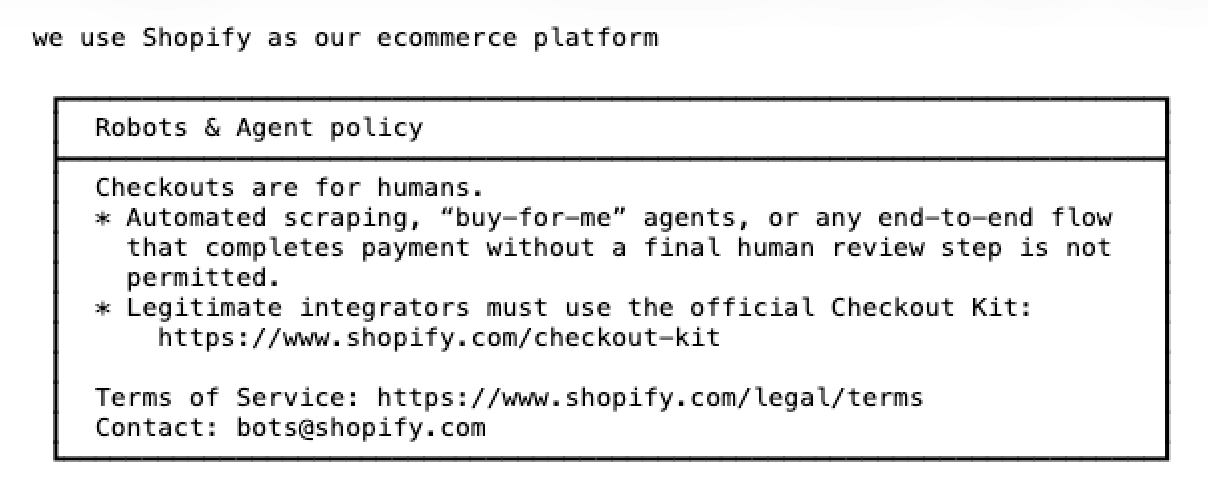
Cast your eyes back to a screenshot from December 2025. Back then, Shopify had a ‘Robots & Agent policy’ section that made one thing crystal clear: checkouts are for humans. It flat-out banned automated ‘buy-for-me’ agents, scraping, or any end-to-end purchasing flows that finalised payments without an actual human giving it the green light. If you were a legitimate integrator, Shopify pointed you straight to their official Checkout Kit.
Notice anything missing? Yep, there was zero mention of UCP.
Fast forward to now, and the addition of UCP and MCP language is incredibly interesting. Shopify’s updated agent policy now directs AI agents toward official UCP/MCP endpoints or the Shopify shopping skill. While they are still fiercely protecting the actual checkout line, they’ve now carved out a sanctioned, approved path for AI agents to handle catalogues, carts, and checkout workflows. The catch? The human buyer still has to approve the final payment.
So that UCP wording is a shiny new addition compared to that December 2025 snapshot.
Building the invisible infrastructure
Shopify hasn’t just been thinking about this; they’ve been actively co-authoring the playbook. In January 2026, Shopify Engineering revealed they’ve been working hand-in-hand with Google to co-develop UCP, creating a unified open standard for AI agents to connect and trade with merchants. Essentially, UCP lets merchants lay out exactly what capabilities they support, while AI agents swing by, discover those features, negotiate what they can handle, and smoothly move through the transaction.
Let’s break that down in plain English: UCP is giving AI agents and ecommerce stores a shared, universal commerce language.
Instead of an AI assistant blindly scraping your website, guessing how variations work, filling out forms, and crossing its digital fingers that the checkout doesn’t snap in half, UCP builds a structured bridge. It allows agents to effortlessly find products, build carts, manage secure checkout hand-offs, and monitor orders.
Shopify’s developer docs now show that their MCP tools are rolling out UCP across the entire buyer journey—covering negotiation, authentication, product discovery, carts, checkout, and post-purchase order monitoring.
What’s the takeaway for you? The front-end website isn’t the only surface that matters anymore. The hidden, structured commerce data layer wrapping around your store is becoming incredibly critical.
Meet the new Shop shopping skill
The most exciting part of this whole puzzle? Shopify isn’t just stopping at developer theories or technical documentation. They’ve gone and built an actual, functioning Shop shopping skill.
This skill file frames the Shop app as a full-blown ‘personal shopping assistant’ capable of searching, buying, tracking, returning, and re-ordering items. We’re talking full-circle commerce here, people, not just a glorified product finder. It can handle product searches, track down similar items, compare prices, check order statuses, track deliveries, and manage returns or re-orders.
The skill is clever about security, too. It can hunt down products openly without needing any login info, but the moment someone wants to track an order, it demands authentication. That’s a vital line in the sand—product discovery stays completely open to the world, while personal data stays safely locked behind user-approved access.
When an AI agent searches for products, it expects to see a loaded payload: product titles, prices, descriptions, shop names, images, specs, variant options, variant IDs, checkout URLs, and product IDs. This drives home our absolute number-one point for ecommerce brands: your product data is the ultimate fuel that AI shopping agents use to understand and recommend what you sell. If your data is messy, you’re invisible.
The checkout behaviour is also a brilliant piece of design. The skill can whip up ‘Buy Now’ links using Shopify variant IDs, but it’s strictly instructed never to trick the user into thinking the purchase is fully completed on its own. The actual transaction still happens securely on your storefront. This aligns perfectly with that robots.txt policy we mentioned earlier—checkouts are strictly for humans, and payment requires a real person’s explicit thumbs-up.
This is arguably the most crucial part of the story. Shopify isn’t just rolling out the welcome mat for AI agents; they’re handing them an entire commerce playbook.
This marks a massive shift in mindset. Historically, ecommerce platforms treated checkout bots like a swarm of digital pests to be blocked at all costs. Shopify is still putting up the guardrails against unsafe automation, but it’s actively building the infrastructure for approved AI agents to talk to commerce in a structured way.
The message has changed from a stern ‘bots stay away’ to ‘agents can help out, but you’ve got to play by the rules, and the human still holds the wallet.’ Progress. We love to see it.
It’s way bigger than just winning new customers
Most marketers tend to view AI shopping purely as a fresh channel to acquire new customers, but this new skill proves it’s going to be massive for customer retention and the post-purchase vibe.
Because the skill covers tracking, returns, and easy re-ordering, it closes the loop. Even more fascinating? The Shop app can aggregate orders from email receipts linked to a user’s account—even if they weren’t originally placed on a Shopify store! This shows Shop is aiming to be a universal commerce assistant, not just a helper for Shopify sites.
The implications here are huge.
Imagine an AI assistant helping a customer track down a package, check your returns policy, initiate a return, or instantly re-order a product they bought six months ago. For brands selling consumables, beauty, apparel basics, pet supplies, auto parts, or subscription-style products, this is a golden opportunity to lock in repeat purchases.
For Shopify merchants, your post-purchase experience is now directly tied to your AI visibility. Things like order statuses, crystal-clear return policies, reorderability, and clean product IDs are no longer just dry operational details. They are active factors dictating how easily an agent can assist your customers after that first sale.
Visual commerce is entering the chat
Tucked away inside that Shop skill file is another absolute gem: visualisation.
The documentation explicitly brands virtual try-ons and visual tools as a ‘killer feature.’ It talks about letting users virtually try on clothing, shoes, and accessories, placing furniture or home decor straight into a photo of their living room, or previewing art prints on their actual walls.
If you are a lifestyle, fashion, beauty, furniture, or homewares brand, you need to pay attention.
We are heading toward a future where your product imagery, lifestyle photography, variant accuracy, and visual assets are going to make or break your sales. A listing with low-res photos, sketchy sizing details, vague colours, or messy variant data is going to get absolutely left behind in an AI shopping landscape where visual confidence is everything.
Feed your feed with new Merchant Center fields
To keep up with this, Google has just dropped conversational attributes into Merchant Center. These are optional fields crafted specifically to help AI models and conversational assistants grasp the deep nuances of what you sell. Google notes that these attributes will help shoppers uncover detailed product info across AI-led spaces like AI Mode in Search, while keeping your traditional search performance solid too.
Say hello to the new conversational line-up:
question_and_answer– perfect for feeding product FAQs straight to the bots.document_link– for manuals, setup guides, assembly PDFs, or instructions.related_product– for linking accessories, required parts, or frequently bought items.item_group_title– for extra-clear variant grouping.variant_option– for locking down variant properties like size, colour, width, or memory.popularity_rank– to signal which products are flying out the door across your inventory.
This is a massive mindset shift: your product feeds are no longer just for pushing ads. They are turning into fully machine-readable product knowledge hubs.
For instance, if you run a Kiwi auto parts store, your product title can’t just be ‘Turbocharger XYZ’. You need to make compatibility, fitment, vehicle models, installation notes, warranties, related gaskets, and common customer questions explicitly clear in your feed and on your page.
A furniture store needs to lay out dimensions, materials, shipping boundaries, room layouts, and assembly steps.
An apparel brand needs to detail sizing charts, fabric types, care instructions, and return procedures.
This is exactly the raw material an AI shopping assistant needs to recommend your brand with absolute confidence.
The new UCP checklist for Merchant Center
Naturally, UCP comes with its own set of Merchant Center entry requirements you’ll need to keep an eye on.
Google’s UCP guidelines point out that you’ll need a Merchant Center account in perfect standing with fully approved products. On top of that, your return policies and customer support details must be completely configured inside Merchant Center, because the AI references these heavily during the checkout experience.
Google has also mapped out specific product feed attributes required for UCP checkout eligibility and compliance. You’ll see fields like native_commerce (which opts your item into checking out directly on Google), consumer_notice (for legal or safety alerts), and merchant_item_id (which maps your feed ID to the exact ID expected by your store’s Checkout API).
For ecommerce marketers, this is critical to wrap your head around because UCP readiness isn’t just a task you can dump on your developer. It touches your entire Merchant Center health, feed structure, store policies, support info, compliance messaging, and product identifiers.
For the vast majority of Shopify stores, the takeaway is beautifully simple: the cleaner your feed, policies, and product data, the better positioned you are for the age of agentic commerce.
What your Shopify store should do right now
Don’t worry about chasing down every single shiny new AI endpoint. Your immediate job is simply to get the fundamentals completely sussed. Here is your Empire9 action plan:
- Audit what your store is already whispering to the bots. Take a close look at your
robots.txt,llms.txt,agents.md, and any UCP-related endpoints. Whatever you do, don’t go blindly overriding things. These files are becoming the map AI agents use to read your site, and messy edits can wreck your organic rankings. - Give your core Merchant Center feed a serious clean-up. Make sure product titles, descriptions, GTINs, MPNs, brands, imagery, pricing, stock levels, shipping, and returns are 100% accurate. AI shopping isn’t a magic wand that fixes broken product data—if anything, it’ll just widen the gap between immaculate stores and messy ones.
- Optimise for absolute answerability. Your product pages need to answer the exact questions real people ask before tapping ‘buy’. Is it compatible? How big is it in real life? What materials are used? Does it actually work in New Zealand? How fast does it ship from the warehouse? What happens if it doesn’t fit? What accessories do I need to buy with it? What’s the warranty?
- Lean heavily into local trust signals. For Kiwi merchants, this is your ultimate superpower against global giants. Make it obvious if items ship from New Zealand (especially if they ship from right here in Christchurch!), give realistic local delivery times, show GST-inclusive pricing, clarify NZ warranty support, and make local returns easy.
- Start with your heavy hitters. You don’t need to enrich all your SKUs in a single night. Start with your bestsellers, your high-margin products, the items crushing it in your Shopping Ads, or the specific products that currently trigger a mountain of customer support tickets.
Why this breaks down the walls between SEO and Paid Media
Welcome to the great convergence. This is the exact moment where SEO, paid media, feed optimisation, and CRO (conversion rate optimisation) pack up their separate offices and move in together.
In the old days, ecommerce teams could keep these roles neatly siloed. SEO took care of the organic blogs, paid media ran the Google Shopping and Performance Max campaigns, developers handled the Shopify backend, and merchandisers sorted the physical products.
AI shopping just smashed those walls down.
Think about it: if Google’s AI models are pulling from product feeds, structured attributes, customer reviews, product copy, shipping rules, and real-time intent signals to choose what to display, then your feed quality is now an organic visibility issue just as much as a paid ad issue.
The humble product page isn’t just a landing page built for conversion anymore—it’s an active data source for an AI. Your Merchant Center feed isn’t just an ad utility—it’s a core machine-readable product knowledge layer. And those agent-facing Shopify endpoints? They aren’t just technical quirks for developers to look at—they are the gateways through which AI agents will discover, interpret, and buy from your store.
The scary bit: The rise of zero-click commerce
Look, let’s be real—there is a definite flipside to this coin.
If AI assistants can answer product questions directly, weigh up items inside Google’s ecosystem, and drop shoppers right into a checkout flow without them ever clicking onto your website, classic web traffic sessions are going to take a hit for certain searches.
That doesn’t mean your actual website is dead. But it does mean your analytics tracking is about to get a whole lot more complex.
While Search Console can track impressions and clicks from AI Overviews under specific rules, zero-click interactions are notoriously tough to track through traditional GA4 setups.
That is precisely why Merchant Center’s new AI performance insights tool is so incredibly exciting. If Google gives us an authentic look into our share of voice, journey stages, search terms, and structured attributes, it will become our first true weapon for tracking AI shopping visibility.
For ecommerce marketers, the new battlefield isn’t just tracking who clicked through to your site—it’s understanding exactly who was considered in the background.
The massive win for Kiwi ecommerce
Down here in New Zealand, local ecommerce brands are constantly punching above their weight, going toe-to-toe with massive overseas giants boasting massive product ranges, bottomless budgets, and super mature feed operations. AI shopping could admittedly stir things up in a few categories.
But here’s the beauty of it: it rewards absolute clarity.
A local Shopify store that clearly communicates ‘ships from Christchurch,’ ‘includes full NZ warranty,’ ‘compatible with New Zealand models,’ ‘2 to 4 working day delivery,’ or ‘built for Kiwi conditions’ is going to get a massive leg up when local search intent kicks in.
The brands that dominate this new era won’t be the ones stuffing keywords onto a page like it’s seasoning on chips (remember that dinosaur era of SEO?). They will be the ones with the cleanest product data, the highest-quality visuals, the strongest trust signals, and the most genuinely helpful, comprehensive answers.